“Custom” is one of the most overused words in the building game. Everyone says they do it. Every website claims it. Every brochure has it plastered across the front. But in reality…
A lot of what’s being sold as custom is just project building.
And unfortunately, most homeowners don’t realise the difference until they’ve already moved in. Here’s some custom home regrets example you should take note of.
A True Custom Home Has Endless Flexibility
Now, obviously “endless” comes back to budget – you can only build what you can afford. But within that, you’ll never be boxed into somebody else’s template.
You can start from a totally blank slate, or you can pull ideas from existing floor plans. You might like one existing plan’s kitchen, another’s living area, and another’s backyard. Doesn’t matter. You can blend ideas from 20 different floor plans if you want.
And then, for each zone, you can zoom right in – choosing the finishes, fixtures, and fittings that’ll bring even more life and character to your design.
That’s what true custom means.
What about When “Custom” Is Just a Sales Word?
There’s definitely plenty of what I call “fake custom” homes out there.
You’ll see builders claiming they do custom jobs, but they’re doing 20, 30, 40 houses a year. At that volume, it’s very hard to be genuinely niched as a high-quality custom builder. Something’s gotta give.
You’ll find that a lot of these builders will say they’re custom, but when you dig a little deeper, you really only have options A, B, or C to choose from. Move a wall here or here. Swap the master bedroom with bedroom two. Pick between this kitchen splashback and that one. To be honest, that’s closer to a set menu than anything remotely custom.
It isn’t the same as sitting down and tailoring a home specifically to you.
How to Tell the Difference Before You Sign
It comes down to doing a bit of homework.
Look at a builder’s previous projects. Are they genuinely different from one another? Or are they variations of the same base plan?
Next, pick up the phone – or better, organise a face-to-face meeting – so you can have a frank conversation with a prospective builder. Ask them what choices you actually have, and pay attention to the language they use.
If the answer is, “You can choose between these three options,” that tells you something.
If the answer is, “You’ve got endless choice; let’s design it around what you want,” that tells you something else.
If you move into the design phase with a builder, pay close attention to how much time they’re genuinely willing to invest in the process. Are they prepared to go room by room and really fine-tune it, or are they rushing you through?
By the time you finish designing a true custom home, it often looks nothing like the starting point.
That’s usually a good sign.
A $1.2 Million Fake Custom Mistake
We recently completed a home for clients who’d already built before with what I’d call a smaller project builder.
The builder wasn’t doing hundreds of homes, but they were still operating at a volume where design flexibility was limited.
These clients spent over $1.2 million on the home. And they hated living in it.
Not because it leaked or fell over. But because it wasn’t designed for them.
They’re tall people, but the bench tops were built at a standard height. Same with the basins. Every time they did the dishes or brushed their teeth, they were hunching over. It got to the point where their backs were hurting.
Now, that sounds small. But when you multiply small oversights like this across an entire home, and when someone has to deal with it every single day, it becomes very frustrating very quickly.
When we built their new home, we adjusted those details. Higher benches. Higher basins.
Small, simple details like that are what separate a house that feels great on handover day… from a home that still feels great 20 years down the track.
They’re the difference between fake custom and real custom.
Bottom Line: Your Home Shouldn’t Feel Like Something You Have To Tolerate
It’s a big investment. If you’re going to do it, do it properly.
Make sure the word “custom” actually means something in your build.
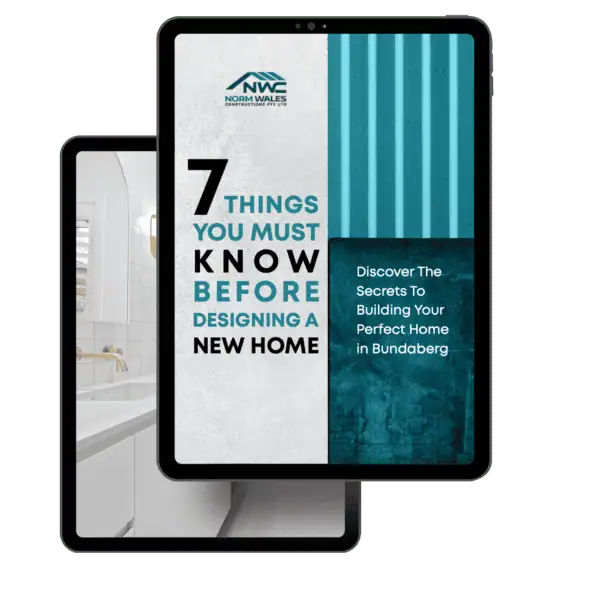
Of course, there’s a lot more to finding the right builder than what we’ve covered here today. That’s why I’ve created this free guide for you to download:
Build with Confidence: 7 Things You Must Know Before Designing a New Home
It’s packed with practical advice to help you ask the right questions, spot red flags early, and plan your build with confidence.
Because once you know what to look for in a builder, you’re already halfway to building your home the right way.
Get to know the man behind your dream home, Norm. Norm Wales Constructions is honored to be APB, and MBA members.